The Quiet Revolution: How Japanese Fashion Is Winning Over American Closets One Understated Piece at a Time

Photo: naotakem, CC BY 2.0, via Wikimedia Commons
Something is shifting in American fashion, and it's happening almost silently — which is, honestly, very on brand for what's driving it.
Scroll through the feeds of the most-followed style accounts right now and you'll notice something interesting: fewer logos. Fewer statement pieces screaming for attention. More linen. More interesting silhouettes in muted tones. More pieces that look expensive without announcing a price tag. And woven through all of it — sometimes subtly, sometimes not — a distinctly Japanese sensibility that's been quietly infiltrating American style for years and has finally hit a tipping point.
Call it quiet luxury meets kawaii. Call it the anti-trend trend. Call it what it actually is: a cultural correction.
How We Got Here
For a solid decade, American fashion was loud. Logomania ruled the early 2010s. Hypebeast culture made streetwear into a competitive sport. Fast fashion gave everyone access to trend-of-the-moment pieces at a pace that made keeping up feel like a full-time job. Even the "clean girl" aesthetic that dominated 2022 was, at its core, a performance — a very specific, very curated version of effortlessness that required enormous effort and a very particular body type.
And then people got tired.
Gen Z, especially, started pushing back. Studies and surveys consistently show that younger consumers are more skeptical of brand loyalty, more interested in sustainability, and more drawn to personal style than trend cycles. They grew up watching fast fashion destroy the environment and create a culture of disposability. They're not interested in buying a micro-trend that'll be embarrassing in eight months.
Enter Japanese fashion philosophy — which has been saying this all along.
The Japanese Fashion Mindset (And Why It Resonates Right Now)
Japanese fashion has never been a monolith. From the maximalist street style of Harajuku to the severe minimalism of brands like Issey Miyake and Comme des Garçons, Japan has always embraced contradiction. But the thread connecting all of it is intentionality. Japanese fashion culture, broadly speaking, doesn't dress to follow — it dresses to express.
The two aesthetics that are most influencing American wardrobes right now exist at opposite ends of the spectrum, and yet somehow they're merging into something new.
Quiet luxury — the preference for high-quality basics, natural fabrics, understated silhouettes, and zero visible branding — has deep roots in Japanese fashion houses and the concept of boro (the art of mending and reusing textile), which values the integrity of the garment over its flashiness.
Kawaii — which literally translates to "cute" but encompasses an entire philosophy of playfulness, softness, and self-expression through detail — is the counterpoint. It's the tiny embroidered mushroom on your tote bag. The pastel cardigan worn over a sleek slip dress. The hair clip that's just a little bit whimsical.
Together, they create something that American fashion has been hungry for: a way to dress that is both refined and fun. Sophisticated but not stiff. Minimal but not cold.
"My clients used to come in wanting to look like they stepped off a yacht," says Brooklyn-based stylist Yuki Ames, who has worked with influencers and fashion editors across New York. "Now they're coming in with screenshots of Japanese street style, Uniqlo lookbooks, and vintage Comme pieces. They want quality and personality. They're done performing wealth."
The Pieces Driving the Shift
You don't need to fly to Tokyo or spend a fortune to understand what's happening here. The pieces themselves tell the story.
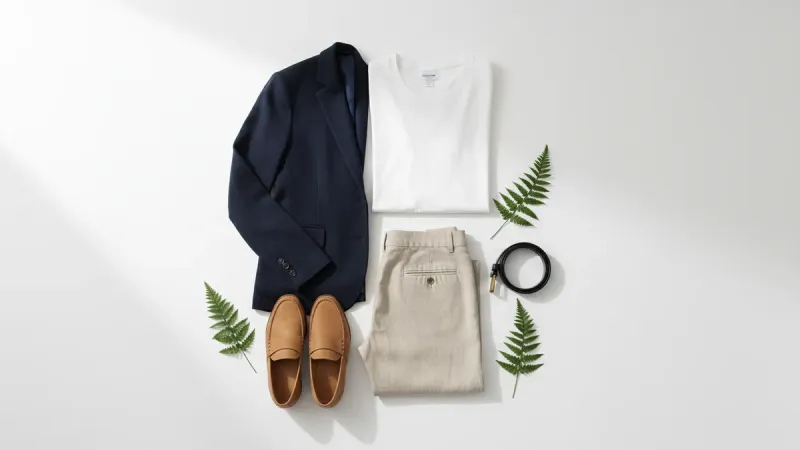
The perfect white shirt. Not the oversized Oxford, not the crisp button-down — the slightly relaxed, slightly sculptural white shirt that exists in a category of its own. Japanese brands have been doing this for decades (Uniqlo's collaboration pieces, Muji's wardrobe staples). American women are finally catching on that a really good white shirt is worth more than ten trend pieces.
Interesting textures in neutral tones. Waffle knit, seersucker, raw linen, bouclé — the Japanese fashion approach favors tactile interest over visual noise. The color palette stays quiet (ecru, slate, moss, warm white, deep navy) while the fabric does the talking.
The unexpected detail. This is where kawaii sneaks in. A button-down with tiny floral embroidery at the collar. A tote bag with a subtle character print. Socks with a pattern that only your closest friends will notice. It's personality expressed in whispers rather than shouts.
Proportion play. Japanese fashion is masterful at silhouette — the wide-leg trouser with a fitted top, the oversized blazer with a delicate slip dress underneath, the cropped jacket over a long skirt. These combinations feel intentional and considered rather than trend-driven.
The Influencers and Stylists Shaping the Conversation
A new wave of fashion voices is making this aesthetic accessible and genuinely exciting for American audiences.
Creators like @tokyostreetdiary and @slowfashionwitch (both with significant US followings) have built entire platforms around the intersection of Japanese style sensibility and everyday American life. They're not styling luxury hauls — they're showing how a $29 Uniqlo ribbed tank becomes something beautiful when worn with the right vintage trousers and a single piece of interesting jewelry.
Fashion influencer and Chicago-based content creator Maya Sato (who has built a following of 180K on TikTok) describes her style as "Japanese-American realism." "I grew up between two aesthetics," she says. "Japanese fashion taught me that less is more interesting. American fashion taught me to be bold. The combination is where I live now."
Her most-saved post? A video breaking down why she spent $80 on a single Muji linen shirt instead of five shirts from a fast fashion retailer — and why the math actually makes sense.
Your Shopping Guide: Get the Look Without Going Broke
Here's the secret the fashion industry doesn't love: this aesthetic is affordable if you're intentional.
Start with Uniqlo. Seriously. Their U line (designed by Christophe Lemaire) and their core basics are the closest thing to Japanese quiet luxury at American mall prices. The linen shirts, ribbed knitwear, and wide-leg trousers are genuinely excellent.
Shop Muji for the details. Their accessories and home goods crossover into fashion in the best way — canvas totes, simple jewelry, and their textile pieces have a distinctly Japanese quietness that works beautifully.
Hit vintage and thrift for texture. Bouclé jackets, linen blazers, interesting knitwear — these show up constantly at Depop, ThredUp, and local thrift stores at a fraction of retail. The imperfection is part of the charm (very wabi-sabi).
Invest in one quality piece. Whether it's a really good bag, a pair of Japanese selvedge denim, or a single beautiful ceramic piece of jewelry — having one thing that's genuinely excellent elevates everything around it.
Add the kawaii touch last. Once your base is quiet and considered, let one small thing be playful. A charm on your bag. A printed sock. A tiny embroidered patch on your denim jacket. It should feel like a secret, not a statement.
Why This Isn't Just a Trend
Here's what's different about this particular fashion moment: it's rooted in values, not just aesthetics. The women gravitating toward this style aren't just chasing a look — they're opting out of a system. They're choosing to buy less, choose better, and dress in a way that reflects who they actually are rather than what algorithm served them last Tuesday.
Japanese fashion philosophy has always understood something that American consumer culture is only now starting to reckon with: the most powerful statement you can make is a considered one.
Your closet doesn't need to be louder. It needs to be yours.
And honestly? That's the most fashionable thing we've heard in years.